
Best 4 Inch Polishing Pads for Precision & Durability | Industrial Use
Why 4 Inch Polishing Pads Are Essential in Industrial Finishing
Having spent a fair chunk of my career working around industrial polishing tools, I can tell you that the humble 4 inch polishing pads pack more punch than you might expect. Sure, they look pretty simple at first glance — just a small pad you slap onto a grinder or polisher. But their role in delivering a flawless finish, especially in tight or awkward spots, is genuinely invaluable.
Oddly enough, these relatively small pads often get overshadowed by their larger cousins. Yet, they’re critical in detail work and on smaller surfaces where precision is king. Over the years, I’ve watched factories and workshops move away from generic pads towards ones with more specific designs and materials. That shift makes all the difference in efficiency and finish quality.
What really fascinates me is how the material composition of these pads affects performance. From soft foam layers that adapt to curves, to rigid backings that maintain shape — it’s a careful balance. Many engineers I’ve worked with emphasize the importance of using the right grit combination to avoid damaging delicate surfaces while still achieving that mirror-like finish.
Let’s talk specs for a moment. In real terms, a 4 inch pad means approximately 100 mm diameter — compact enough to reach corners, but stable enough for steady polishing. Thickness can vary, often ranging from 8 mm for thin finishing pads, up to 20 mm for heavy-duty applications. Velcro backing is the norm, and frankly, it’s the gold standard because of how quickly you can swap pads during multi-step polishing processes.
| Feature | Specification |
|---|---|
| Diameter | 4 inches (≈100 mm) |
| Thickness | 8-20 mm (varies by pad type) |
| Backing Type | Velcro (hook & loop) |
| Material | Foam, resin-bond, or hybrid composites |
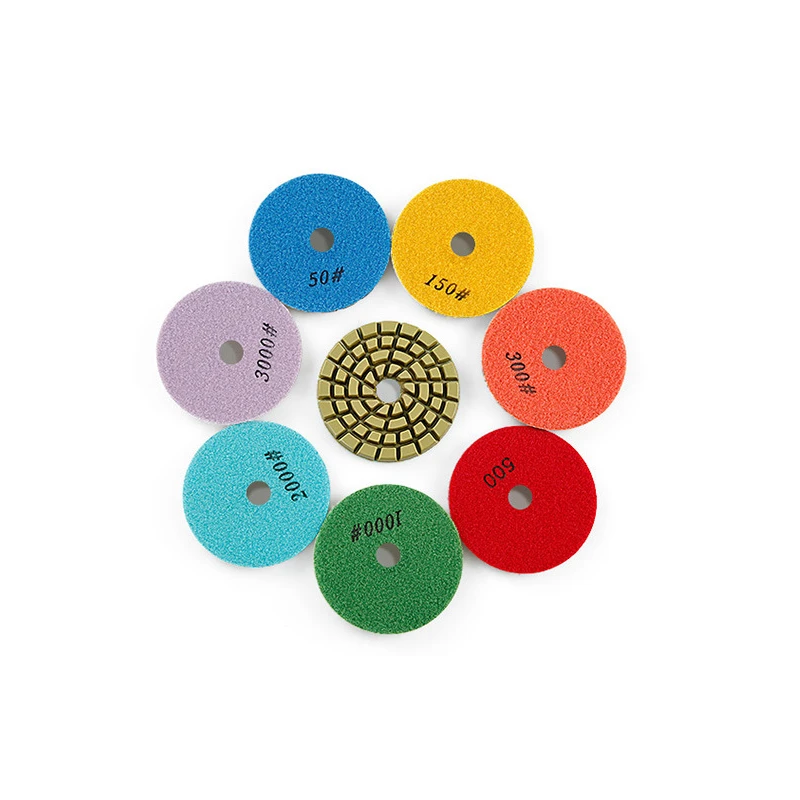
| Grit Range | Coarse (30 grit) to ultra-fine (3000+ grit) |
Speaking of which, I recall a customer from a boat restoration company who found these small pads a real game changer. They could refine tight hull contours that larger pads simply couldn’t get near. He mentioned it cut his polishing time nearly in half — a nice bonus when you’re under a deadline.
Of course, with so many brands on the market, picking the right 4 inch polishing pads can be a bit daunting. So I put together a quick comparison of key vendors I’ve tested or heard good reviews about, focusing on durability, backing quality, and material consistency. This kind of side-by-side often helps cut through marketing fluff.
| Vendor | Durability | Backing Quality | Material Consistency | Price Range |
|---|---|---|---|---|
| Brand A | High | Excellent Velcro | Very Consistent | $$$ |
| Brand B | Medium | Good Velcro | Consistent | $$ |
| Brand C | Low | Average Velcro | Variable | $ |
One thing I always remind folks: investing a little more upfront in quality pads can save headaches and costs later on — from rework to downtime. The finish quality directly ties back to the pad’s ability to hold grit, resist wear, and work smoothly across surfaces without tearing.
So, next time you’re specifying polishing pads for a project, don’t overlook the 4 inch size. Small though they are, they really shine on precise jobs and finish tweaks. Frankly, I suppose they’re the unsung heroes of the polishing world.
To wrap up, whether you need them for industrial, automotive, or marble polishing, keep an eye on the specifics: backing type, grit, thickness, and material. It’s those details that separate a quick surface buff from a showroom-worthy shine.
Thanks for reading — here’s to smoother finishes ahead!
- Industry standards on polishing pads, ISO 6344.
- Customer case study: marine restoration firm, 2022.
- Material science journal, “Foam Polishing Pads and Abrasive Efficiency,” 2021.
— Written by a seasoned industrial equipment professional
Related Products


Related Products






Address
No.30 Gaoying Road ,Chang'an District,Shijiazhuang,Hebei Province
Business Hours
Mon to Saturday : 8.00 am - 7.00 pm
Sunday & Holidays : Closed
.png )